Plenary Lecture
Large Eddy Simulation of turbulent reacting flows: methods and applications
Bénédicte Cuenot
CERFACS, Toulouse, France
Thanks to the development of efficient massively parallel computing, Large Eddy Simulation (LES) has emerged in the past decades as a powerful numerical approach to meet the challenge of turbulent reacting flow simulation. By solving the filtered unsteady problem on refined grids, LES is able to provide reliable predictive solutions of both academic configurations and real industrial systems, and gives new insight into the underlying physical phenomena.
Turbulent combustion involves various interacting physical phenomena which must be described and coupled. This includes turbulence, chemistry, heat transfer, acoustics, but also two-phase flows and phase change to account for liquid fuel, or solid particle dynamics and heterogeneous chemistry for soot prediction. Non-linearity, associated to a wide range of space and time scales, make the full resolution of turbulent combustion not affordable for practical applications. Models are therefore required to reduce the problem complexity and describe the unresolved sub-grid scale processes. These models must be efficient, accurate, reliable, and take into account the interactions between the various physics.
In the lecture an overview of the physical models used for LES of turbulent reacting flows will be given, focusing on the most recent and successful approaches. The methodology based on validation test cases to ensure accuracy and reliability will be described and discussed. A selection of applications will be then presented, in the fields of aerospace propulsion, energy production, as well as chemical and industrial processes. Comparison with experiments and results analysis will allow to demonstrate the capacity of LES to predict the behavior of complex problems. The lecture will conclude with some perspectives on modelling but also numerical and computational aspects.
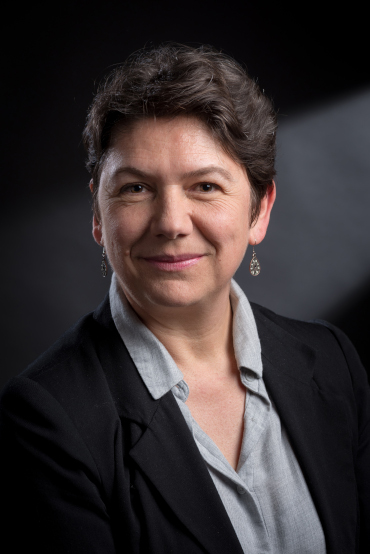 Dr. Bénédicte Cuenot obtained her engineering and master degree from Ecole
Centrale de Paris in 1990. After one year as research engineer in the
University of Boulder (CO, USA), she came back to France where she defended her
PhD in 1995 and HdR in 2000, both in the field of numerical combustion. She is
now the leader of the combustion research group at CERFACS, developing advanced
and massively parallel softwares for the numerical simulation (DNS and LES) of
turbulent combustion and heat transfer (including thermal radiation) in
industrial systems. With these tools she addresses various topics such as
pollutant emissions, ignition and extinction, combustion efficiency or thermal
fatigue of combustion chambers. Dr. Cuenot teaches combustion and fluid
mechanics in various universities and has authored more than 80 peer-reviewed
journal papers. She has participated to many collaborative projects at the
national and international level, and is much experienced in coordinating
european projects, mostly financed by the European Commission where she also
acts as an expert evaluator. She has been distinguished as a Fellow of the
Combustion Institute in 2018 and is a member of the Editorial Board of
Combustion and Flame since 2018.
Dr. Bénédicte Cuenot obtained her engineering and master degree from Ecole
Centrale de Paris in 1990. After one year as research engineer in the
University of Boulder (CO, USA), she came back to France where she defended her
PhD in 1995 and HdR in 2000, both in the field of numerical combustion. She is
now the leader of the combustion research group at CERFACS, developing advanced
and massively parallel softwares for the numerical simulation (DNS and LES) of
turbulent combustion and heat transfer (including thermal radiation) in
industrial systems. With these tools she addresses various topics such as
pollutant emissions, ignition and extinction, combustion efficiency or thermal
fatigue of combustion chambers. Dr. Cuenot teaches combustion and fluid
mechanics in various universities and has authored more than 80 peer-reviewed
journal papers. She has participated to many collaborative projects at the
national and international level, and is much experienced in coordinating
european projects, mostly financed by the European Commission where she also
acts as an expert evaluator. She has been distinguished as a Fellow of the
Combustion Institute in 2018 and is a member of the Editorial Board of
Combustion and Flame since 2018.